
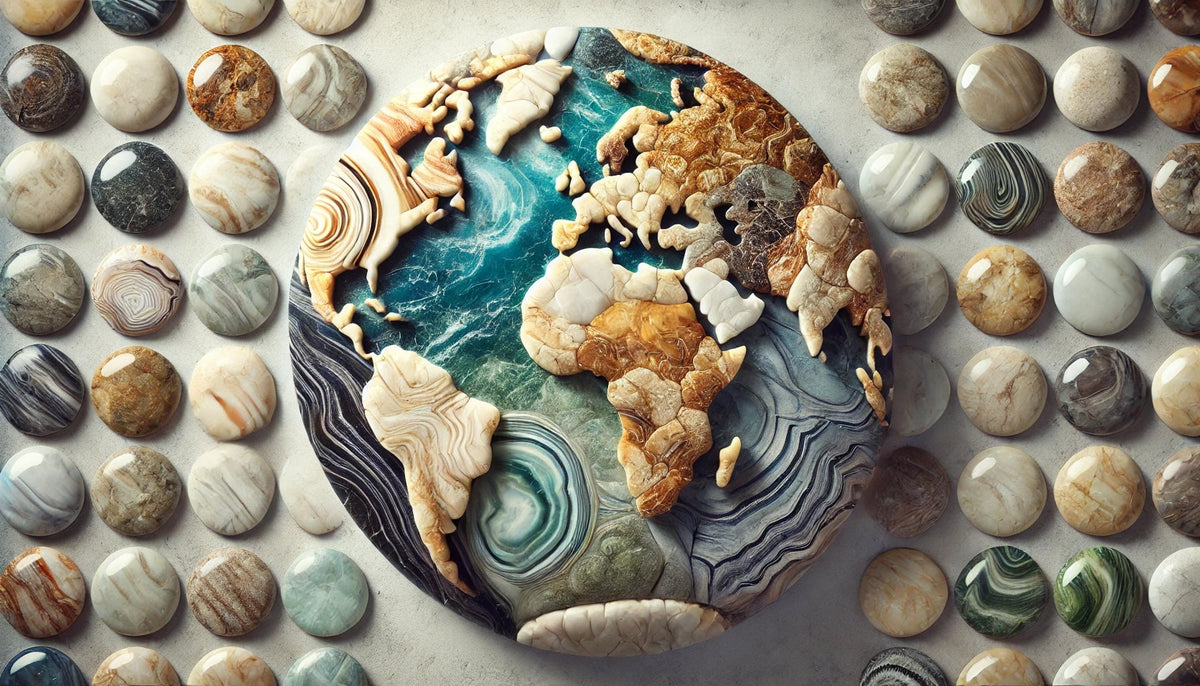
Natural stone is an incomparable gift from nature—shaped over millions of years by geological processes that have left traces of time and the elements within. Each stone tells its own story, shaped by the region it comes from and the culture that has used it for centuries.
At MAGNA Atelier, we work with some of the world's most beautiful and fascinating natural stones. Each individual stone brings not only aesthetic uniqueness to our designs, but also a deep respect for its origin.
1. Calacatta Viola – A masterpiece of Tuscany
Calacatta Viola marble has been mined for centuries in the famous marble quarries of Tuscany, particularly in the Apuan Alps. This region is known not only for its breathtaking scenery but also for its historical significance in art and architecture.
Michelangelo chose marble from these quarries for his world-famous sculptures, and to this day Calacatta Viola is considered a symbol of Italian elegance and craftsmanship.
The stone is characterized by its creamy white base color, interspersed with dramatic purple-dark red veins. This striking pattern makes it a sought-after choice for luxurious interiors. Its rarity and careful extraction in small batches make Calacatta Viola an exclusive material that combines Italian history and contemporary design.
To the product
2. Taj Mahal Quartzite – The golden elegance from Brazil
The name “Taj Mahal Quartzite” immediately evokes associations with the world-famous Indian mausoleum, which is considered a symbol of eternal love.
But curiously, this natural stone does not come from India, but from the tropical quarries of Brazil, a country known for its geological diversity and exceptional natural stones.
While the actual Taj Mahal in India was built from the snow-white Makrana marble from Rajasthan, the Brazilian Taj Mahal quartzite only shares its name and graceful elegance with the building.
The warm creamy white to golden color of the Taj Mahal quartzite is complemented by gentle, flowing veins that are reminiscent of the fine decorations of the Indian mausoleum.
This quartzite combines beauty with exceptional hardness and durability, making it ideal for luxurious yet everyday applications such as tables, kitchen countertops or wall cladding.
The story associated with the name Taj Mahal is also interesting. The white Taj Mahal, a masterpiece of Mughal architecture, was built by Shah Jahan as a tomb for his beloved wife, Mumtaz Mahal.
But what is less well known is that Shah Jahan allegedly planned to build another structure, a "Black Taj Mahal," as his own mausoleum. This counterpart, made of jet-black marble, would stand on the opposite bank of the Yamuna River and mirror the white Taj Mahal. However, the plan was never realized, presumably due to financial and political reasons.
3. Nero Marquina – The Black Treasure of Spain
Nero Marquina marble comes from quarries in the Basque Country region of northern Spain. This area has a rich history of natural stone processing dating back to Roman times.
The deep black marble with its bright white veins is a symbol of timeless elegance and is often associated with prestige and luxury in Spanish cultures.
Its name derives from the town of Marquina, which was historically a center of marble production. Nero Marquina is still mined today using complex processes to preserve the stone's quality and unique contrasts.
It is perfect for minimalist and modern designs and is used in both elegant living spaces and prestigious business areas.
To the product
4. Green Onyx – The mysterious beauty of Pakistan
Green onyx, a translucent, emerald-green stone, originates from the desert regions of Pakistan, particularly the Khyber Pakhtunkhwa province. This region is known for its rich onyx deposits and a millennia-old craftsmanship that has shaped the stone since ancient times. Onyx has historically been used for religious and spiritual purposes, as it is believed to have calming and harmonizing effects.
Green Onyx captivates with its rich green color, interspersed with fine white or golden veins. In Islamic architecture, the stone was often used for mosques and palaces, where its translucent properties created a magical effect. Today, Green Onyx is primarily used for decorative applications, such as tabletops, wall cladding, or illuminated design objects that fill spaces with a touch of mysticism.
To the product
Natural stone is an incomparable gift from nature—shaped over millions of years by geological processes that have left traces of time and the elements within. Each stone tells its own story, shaped by the region it comes from and the culture that has used it for centuries.
At MAGNA Atelier, we work with some of the world's most beautiful and fascinating natural stones. Each individual stone brings not only aesthetic uniqueness to our designs, but also a deep respect for its origin.
1. Calacatta Viola – A masterpiece of Tuscany
Calacatta Viola marble has been mined for centuries in the famous marble quarries of Tuscany, particularly in the Apuan Alps. This region is known not only for its breathtaking scenery but also for its historical significance in art and architecture.
Michelangelo chose marble from these quarries for his world-famous sculptures, and to this day Calacatta Viola is considered a symbol of Italian elegance and craftsmanship.
The stone is characterized by its creamy white base color, interspersed with dramatic purple-dark red veins. This striking pattern makes it a sought-after choice for luxurious interiors. Its rarity and careful extraction in small batches make Calacatta Viola an exclusive material that combines Italian history and contemporary design.
2. Taj Mahal Quartzite – The golden elegance from Brazil
The name “Taj Mahal Quartzite” immediately evokes associations with the world-famous Indian mausoleum, which is considered a symbol of eternal love.
But curiously, this natural stone does not come from India, but from the tropical quarries of Brazil, a country known for its geological diversity and exceptional natural stones.
While the actual Taj Mahal in India was built from the snow-white Makrana marble from Rajasthan, the Brazilian Taj Mahal quartzite only shares its name and graceful elegance with the building.
The warm creamy white to golden color of the Taj Mahal quartzite is complemented by gentle, flowing veins that are reminiscent of the fine decorations of the Indian mausoleum.
This quartzite combines beauty with exceptional hardness and durability, making it ideal for luxurious yet everyday applications such as tables, kitchen countertops or wall cladding.

The story associated with the name Taj Mahal is also interesting. The white Taj Mahal, a masterpiece of Mughal architecture, was built by Shah Jahan as a tomb for his beloved wife, Mumtaz Mahal.
But what is less well known is that Shah Jahan allegedly planned to build another structure, a "Black Taj Mahal," as his own mausoleum. This counterpart, made of jet-black marble, would stand on the opposite bank of the Yamuna River and mirror the white Taj Mahal. However, the plan was never realized, presumably due to financial and political reasons.
3. Nero Marquina – The Black Treasure of Spain
Nero Marquina marble comes from quarries in the Basque Country region of northern Spain. This area has a rich history of natural stone processing dating back to Roman times.
The deep black marble with its bright white veins is a symbol of timeless elegance and is often associated with prestige and luxury in Spanish cultures.
Its name derives from the town of Marquina, which was historically a center of marble production. Nero Marquina is still mined today using complex processes to preserve the stone's quality and unique contrasts.
It is perfect for minimalist and modern designs and is used in both elegant living spaces and prestigious business areas.
4. Green Onyx – The mysterious beauty of Pakistan
Green onyx, a translucent, emerald-green stone, originates from the desert regions of Pakistan, particularly the Khyber Pakhtunkhwa province. This region is known for its rich onyx deposits and a millennia-old craftsmanship that has shaped the stone since ancient times. Onyx has historically been used for religious and spiritual purposes, as it is believed to have calming and harmonizing effects.
Green Onyx captivates with its rich green color, interspersed with fine white or golden veins. In Islamic architecture, the stone was often used for mosques and palaces, where its translucent properties created a magical effect. Today, Green Onyx is primarily used for decorative applications, such as tabletops, wall cladding, or illuminated design objects that fill spaces with a touch of mysticism.


